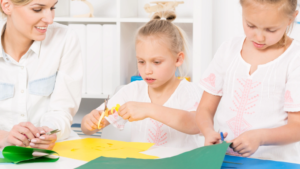

Bilateral coordination is the ability to use both sides of the body together in an organized way. Crossing midline means moving a hand or foot across the imaginary line down the center of the body. These skills support dressing, handwriting, cutting, sports, and even reading eye movements.
If your child switches hands frequently, avoids two-handed tasks, or looks awkward during movement games, these activities can help — and they feel like play.
Why These Skills Matter
- Handwriting: stabilizing paper with one hand while writing with the other
- Cutting: one hand cuts while the other rotates and holds the paper
- Dressing: pulling pants up, zipping, buttoning
- Sports: catching, throwing, kicking with coordination
- Reading: smooth left-to-right visual tracking
10 Easy Games to Try
- Balloon volleyball: tap across the body to keep balloon up
- Cross-body bean bag toss: right hand to left target, left hand to right target
- Windmill touches: touch right hand to left foot and switch
- Animal walks: bear walk, crab walk, inchworm
- Scarf passing: pass a scarf around the body in patterns
- Ribbon drawing: make big figure eights in the air
- Pretend “washing” game: wash left arm with right hand, etc.
- Playground: climbing ladders, monkey bars (with support)
- Kitchen helper: stirring with one hand while bowl is held steady, cutting fruit with plastic knife
- Puzzle stabilization: one hand holds the board while the other places pieces
How to Make Progress Faster
- Do 5 minutes at a time, several days per week
- Use big movements first (whole body) then progress to table tasks
- Model the movement slowly and make it a game, not a correction
- Look for smoother movements and less “switching hands” over time
When OT May Be Helpful
If bilateral coordination is impacting handwriting, cutting, sports participation, or independence skills, an OT evaluation can help determine the best approach and rule out other contributing factors.
FAQ:
Q: What is crossing midline in child development?
A: Crossing midline is moving a hand or foot across the center of the body, supporting coordinated movement and learning skills like writing and reading.
Q: Why does my child switch hands often?
A: Some switching is normal early on, but persistent switching may relate to coordination, strength, or motor planning and can be addressed with practice or OT support.
Q: How can I improve bilateral coordination at home?
A: Use movement games like cross-body toss, windmill touches, and animal walks in short, frequent sessions.